
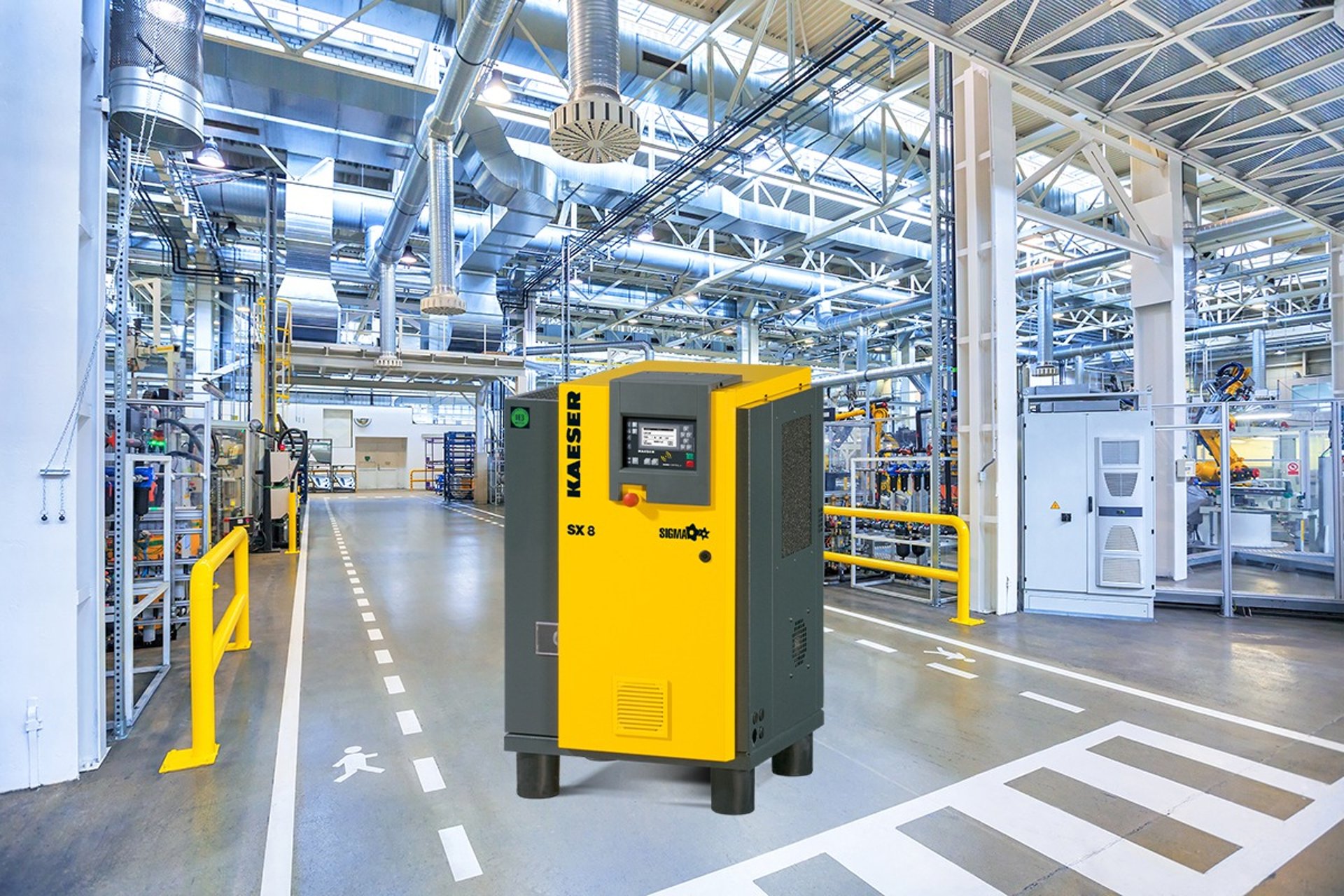
Commercial Air Compressor Products
Optimizing efficiency in compressed air systems.
Air Compressors
We design, supply, install, and maintain compressed-air systems that deliver stable pressure with the lowest total energy cost. Our process begins with the demand side-detecting leaks, analyzing flow variability, and identifying critical end uses-then right-sizes the supply, treatment, and control architecture to match real operating conditions.
What We Deliver
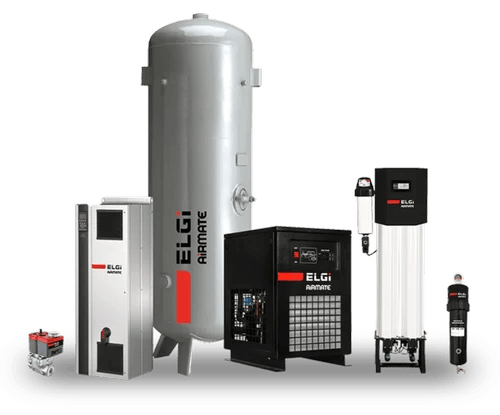
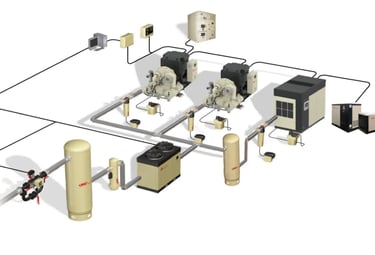
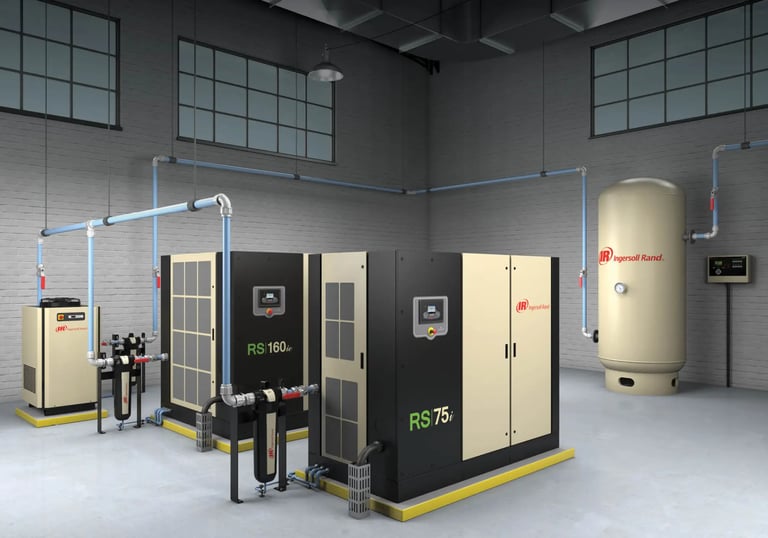
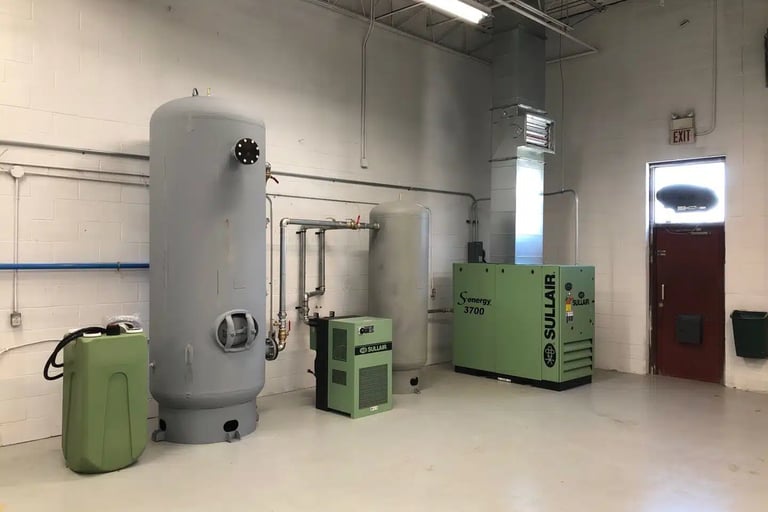
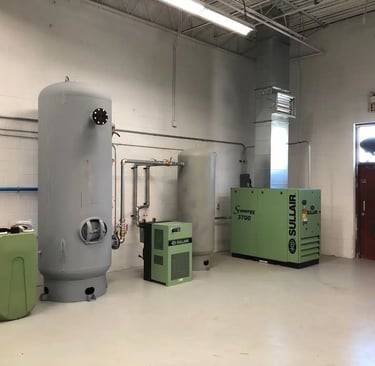
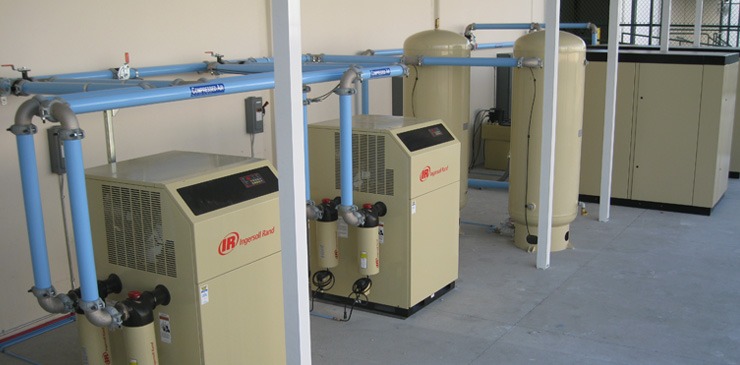
We engineer complete compressed-air systems covering compressors, dryers, filtration, receivers, condensate management, distribution piping, and smart controls.
Technology selection is based on life-cycle cost modeling and duty profile. Options include:
Oil-injected and oil-free rotary screw compressors for continuous duty
Variable-speed drive (VSD) compressors for part-load efficiency
Reciprocating compressors for intermittent or high-pressure applications
Receivers are correctly sized to absorb transients and maintain pressure stability across varying loads and seasonal conditions.
Air Treatment & Quality
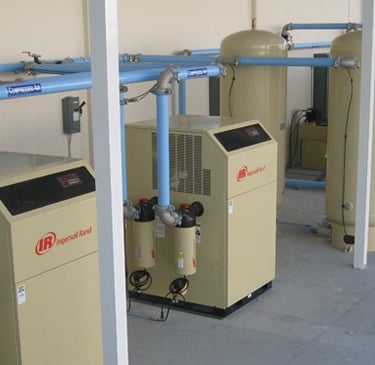
Refrigerated dryers for general industrial air
Desiccant dryers for low dew-point or instrument-air service
Multi-stage filtration (coalescing, particulate, activated carbon) for product and equipment protection
We verify and document oil carry-over, dew point, and particle counts to ensure compliance with the specified air-quality class.
Distribution Network
We design piping for minimal pressure drop, using optimized diameters, looped mains, and properly spaced drops and drains.
Key features include:
Isolation/bypass valves and pressure regulators for zoning and maintenance
Flow meters for consumption tracking
Selection of materials that prevent corrosion and maintain system cleanliness and efficiency
Controls & Monitoring
Smart compressor controls coordinate base-load and trim units, maintaining tight pressure bands and automatic load-sharing.
They manage auto-rotation and off-shift operation for maximum efficiency.
We monitor in real time:
Pressure, flow, temperature, dew point, and specific power (kW/100 cfm or kW/m³/min)
Dashboards and alarms highlight inefficiencies and faults for fast corrective action.
Energy Recovery & Sustainability
Waste-heat recovery from compressors for space or process heating
Demand-side optimization using VFDs, no-loss drains, and point-of-use regulation
Leak tagging programs and performance reporting that quantify energy savings and payback
Safety & Compliance
Our systems include:
Relief valves, ESD circuits, and guarded rotating parts
Proper ventilation and electrical coordination for safe isolation
All designs comply with local codes and OEM standards, supported by risk assessments and method statements before execution.
Commissioning & Documentation
We verify performance through:
Pressure stability tests
Flow and dew-point verification
Leak detection surveys
Specific power benchmarking
Deliverables include as-built drawings, single-line diagrams, data sheets, and O&M manuals.
Operators receive training on start/stop procedures, inspections, and troubleshooting.
Lifecycle Services
We offer preventive and predictive maintenance, including:
Vibration and oil analysis
Filter and separator replacement
Dryer and desiccant service
Condensate management and scheduled overhauls
Regular leak audits and system optimization maintain efficiency.
Remote diagnostics and SLAs define response and restoration times to ensure uptime and reliability.
Brands We Support
ELGi · Champion · Ingersoll Rand . Airman . Comer . Hitachi . AERZEN . Boge . Gardner Denver . Sullair . Kaeser . Atlas Copco
Assessment
We quantify demand and leaks using flow meters, pressure loggers, and ultrasonic detection. Profiles map peak, base, and transient loads by area and shift. Outputs include dew-point needs, specific-power baseline, critical end uses, and a prioritized savings and reliability roadmap.
Technology
We select compressors by duty cycle, pressure, and air quality class: oil-injected or oil-free rotary screw, VSD for turndown, or reciprocating for intermittent/high-pressure tasks. Modeling compares lifecycle cost, efficiency, service intervals, noise, footprint, and integration with dryers and controls.
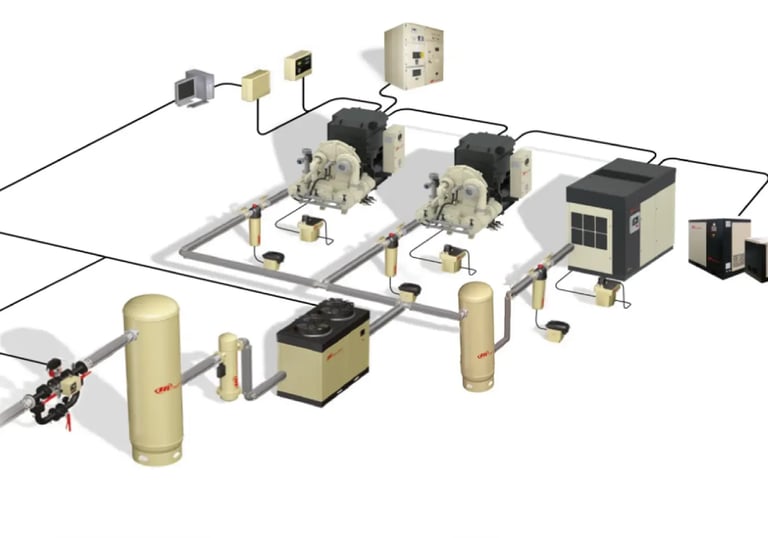
We engineer low-loss distribution: looped mains, right-sized diameters, receivers to decouple transients, and point-of-use regulation. Materials and slopes manage condensate with no-loss drains. Isolation, bypass, flow/pressure monitoring, and filtration/drying ensure clean air, maintainability, and code compliance.
Distribution
FAQs
Compressed air is atmospheric air stored under pressure to power tools, valves, and industrial processes.
Proper system design controls pressure, flow, dew point, and purity in line with ISO 8573-1, protecting equipment, product quality, and energy efficiency across variable loads and shifts.
Why Choose Oil-Free?
Oil-free compressors eliminate lubricant carryover at the source, minimizing contamination risk, filter load, and product recall exposure.
They are ideal for pharmaceutical, food, electronics, and breathing-air applications.
Although capital cost can be higher, the lifecycle cost often decreases through simpler air treatment and fewer downstream failures.
How to Assess My Needs?
Start with a demand-side audit:
Log pressure and flow
Profile base and peak loads
Map critical end uses
Quantify leaks
Define air quality and dew-point targets
Collected data enables right-sizing of compressors, dryers, receivers, piping, and controls, ensuring both reliability and energy optimization.
What Are Refrigerated Dryers?
Refrigerated dryers cool compressed air so water vapor condenses and is removed, typically achieving a +2 to +5 °C pressure dew point.
They are suitable for general industrial use.
For colder environments or lower dew points, use desiccant dryers with pre-filtration to prevent moisture carryover.
What Is a Receiver?
A receiver is a pressure vessel that buffers compressed air.
It:
Stabilizes system pressure
Reduces compressor cycling
Provides reserve capacity for step loads and emergencies
Proper sizing, automatic drains, relief valves, and instrumentation are essential for safe and efficient operation.
How to Reduce Air Leaks?
Conduct ultrasonic leak surveys
Tag, repair, and verify all detected leaks
Replace worn hoses and quick-connects
Install no-loss drains
Lower system pressure where feasible
Use standardized sealants
Track the leakage rate and specific power (kW/Nm³), and perform periodic audits to sustain energy savings and recover lost capacity.
What Is Compressed Air?
Contact
Get in touch
Support
Follow
0503097003
Copyright © 2025 EPTCO All rights reserved
0112422995
0590061269
0112422995

