
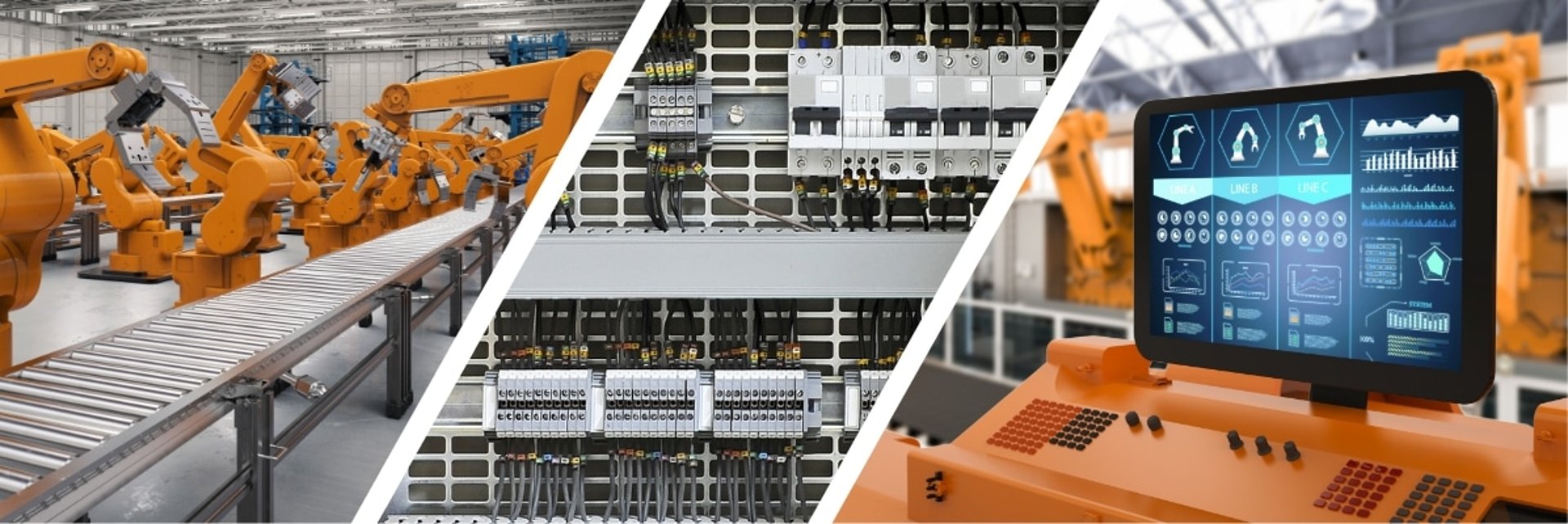
Control & Automation
Comprehensive solutions for control and power managemen
Services
Control & Automation
We design, program, and maintain integrated control systems that enhance safety, uptime, and productivity. Our expertise covers power and control panels, field instrumentation, PLC programming, HMI design, and SCADA architectures that scale from single machines to multi-site facilities. Every project follows a disciplined lifecycle-from requirements definition to commissioning and lifecycle support.
Engineering
Custom power and control panels engineered for uptime and serviceability: MCCs, PLC/remote-I/O cabinets, marshalling, labeling, thermal management, and EMC practices. Delivered with drawings, cable schedules, and FAT/SAT. Built to IEC/UL and local codes with clear maintenance clearances and lifecycle documentation.


Software
Structured, reusable PLC/HMI/SCADA code per IEC 61131-3: function blocks, state machines, and alarm rationalization. Simulated and unit-tested before site work. Version-controlled with naming conventions, comments, and backups. HMIs optimized for usability, multilingual support, and role-based navigation.
Defense-in-depth aligned to IEC 62443: zones and conduits, network segmentation, RBAC, allow-listed services, secure remote access, and audit logging. Patch and firmware governance, backups and disaster-recovery drills, and change control keep systems resilient, compliant, and future-ready.
Security



What We Deliver
Functional design: Development of user requirements, I/O lists, interlocks and permissives, cause-and-effect matrices, alarm rationalization, and fail-safe logic.
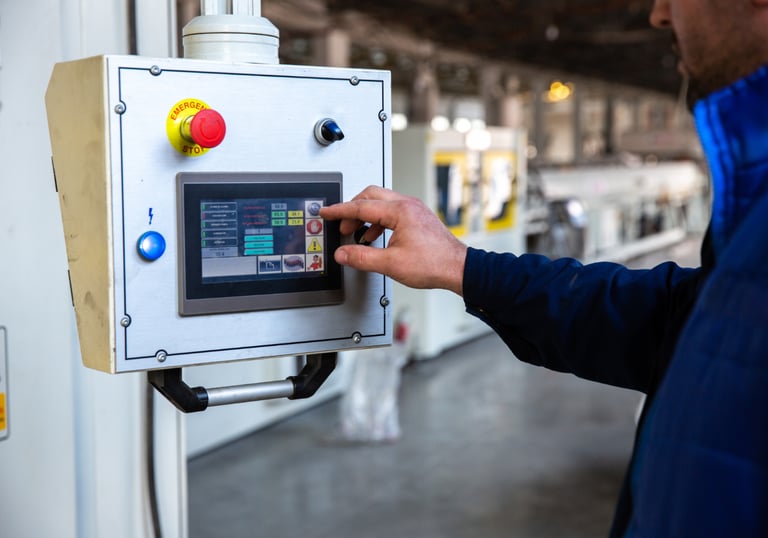
Panels & wiring: Supply of MCCs, PLC/remote I/O cabinets, marshalling panels, intrinsically safe barriers, and coded labeling for efficient maintenance.
PLC/HMI/SCADA: Programming in modular ladder or structured text, using reusable function blocks and multi-language HMIs. Deployment of redundant SCADA servers, historians, trends, and reports for data visibility.
Networks: Implementation of industrial Ethernet, fiber, and fieldbuses (Profinet, EtherNet/IP, Modbus). Use of segmented topologies, managed switches, VLANs, and synchronized time networks.
Cybersecurity: Compliance with IEC 62443 (ISA/IEC-95/99) using zone-and-conduit models, role-based access, allow-listed services, secure remote access, and audit logging.
Integration: Communication via OPC UA/DA, MQTT, and API interfaces with BMS, MES, CMMS, ERP, and LIMS systems; inclusion of recipe control, genealogy, and traceability.
Safety systems: Conducting risk assessments, SIL targeting, interlock matrices, emergency stop validation, and safety function verification.
Documentation: Delivery of P&IDs, loop diagrams, cable schedules, naming conventions, software versioning, and backup archives.
Engineering Approach
We begin with a process and hazard review to define operating modes, startup/shutdown sequences, and abnormal condition responses.
Control narratives translate system objectives into deterministic logic with limited alarm rates for actionable alerts.
Simulations and FAT test benches validate control logic before deployment.
On site, our engineers execute I/O verification, loop tuning, and end-to-end integration tests with connected systems to minimize MTTR and reduce human error.
Data & Performance
We deploy historians to capture high-resolution event data and analog trends.
KPIs such as OEE, energy efficiency, and downtime Pareto are calculated and visualized through role-based dashboards for operators, maintenance, and management teams.
Reports support regulatory compliance and continuous improvement with measurable baselines and targets.
Commissioning & Training
Our FAT/SAT procedures cover:
Device calibration, I/O mapping, and safety-function testing
Network resilience checks and failover validation for redundant servers
Operators receive structured training and standard operating procedures (SOPs) for normal, maintenance, and emergency modes.
Handover includes source code, licenses, backups, and as-built documentation.
Lifecycle Services
Preventive and predictive programs include:
Firmware and patch management
Backup and disaster-recovery drills
Database maintenance and alarm rationalization reviews
Remote support and SLAs guarantee defined response and restoration times.
Change management ensures all system modifications undergo impact analysis and rollback planning.
Standards & Compliance
All systems are designed in line with:
IEC 61131-3, IEC 62443, ISA-5.1, ISA-18.2, ISO 13849, and IEC 62061 (for safety applications)
Local electrical codes and traceable calibration standards
All test instruments are calibrated, and all documentation is controlled, auditable, and revision-tracked.
FAQs
What is your process?
We begin by capturing requirements, mapping hazards, and defining all I/O and safety states.
Then we prepare control narratives, I/O lists, and cause-and-effect matrices, followed by logic simulation during FAT.
On site, we perform I/O checks, loop tuning, and SAT testing before final handover.
How do you ensure security?
We apply IEC 62443 zone-and-conduit segmentation, with managed switches, VLANs, and role-based access control (RBAC).
Only allow-listed services are permitted, with encrypted remote access and audit logging.
Our patch management, firmware governance, backups, and incident-response procedures maintain cyber-resilience and operational continuity without disruption.
What systems do you integrate?
We integrate power and control panels, MCCs, PLCs, remote I/O, HMIs, SCADA, historians, and industrial networks.
Connectivity extends to MES/ERP/CMMS via OPC UA or MQTT, and interfaces with BMS and safety systems for unified alarms, recipes, reports, and traceability.
Do you provide documentation?
Yes. We deliver complete P&IDs, I/O and signal lists, cable schedules, loop diagrams, naming conventions, software backups, version logs, test records, and as-built drawings.
Operators receive SOPs and training materials aligned with acceptance criteria and audit requirements.
What is your expertise?
Our expertise lies in standards-based control engineering across discrete and process industries.
Core strengths include alarm rationalization, safe-state logic, modular IEC 61131-3 code, high-availability SCADA, data historians, and analytics for OEE and energy KPIs—fully integrated with business systems.
How do you handle maintenance?
We implement preventive and predictive maintenance programs covering backups, patching, firmware lifecycle, database optimization, alarm reviews, and disaster-recovery (DR) drills.
Remote support and SLA frameworks define response and restoration targets.
All system modifications are governed by change-management protocols with impact testing, rollback plans, and version control to ensure operational stability and compliance.
Contact
Get in touch
Support
Follow
0503097003
Copyright © 2025 EPTCO All rights reserved
0112422995
0590061269
0112422995

