

Uninterruptible Power Systems Solutions
Reliable UPS architectures for critical systems.
Services
We design, build, and maintain UPS architectures that keep mission-critical loads continuously online. From data centers and healthcare facilities to industrial plants and life-safety systems, EPTCO delivers clean, stable, and reliable power with predictable lifecycle cost and documented availability.
Design
We design UPS architectures tailored to critical loads: select topologies, size ratings and autonomy, and specify N+1 redundancy. Studies cover fault levels, protection coordination, thermal and space limits, maintenance access, and safety. Deliverables include SLDs, settings, method statements, and compliance documentation.
Integration
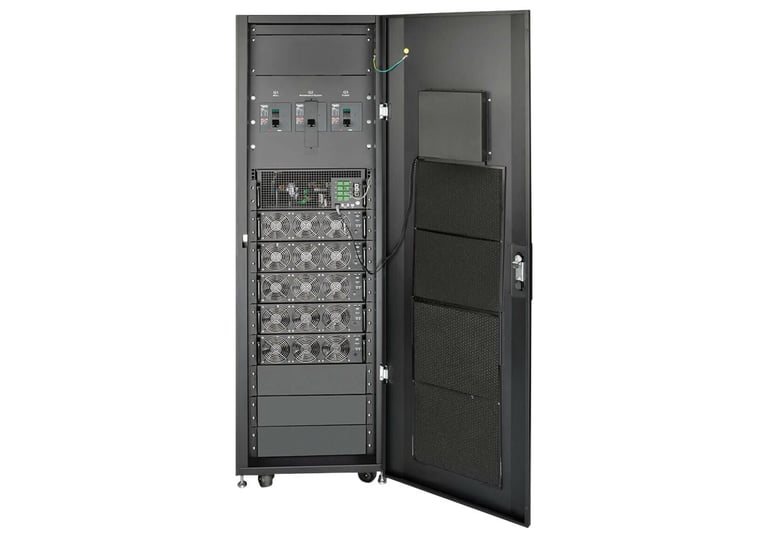
We integrate UPS with generators, switchgear, PDUs, and critical IT/process loads. Designs include static and maintenance bypass, grounding and neutral schemes, EPO logic, and backfeed protection. Monitoring links via SNMP/Modbus to BMS/DCIM with alarms, trends, and automated test routines.
We engineer VRLA AGM/GEL and lithium-ion systems: string counts, cabling, and protection; flame-retardant racks, seismic restraints, and compliant ventilation. Battery management tracks cell voltage, resistance, and temperature. Programs include discharge tests, torque checks, thermography, and safe handling to extend life and reliability.
Battery
What We Deliver
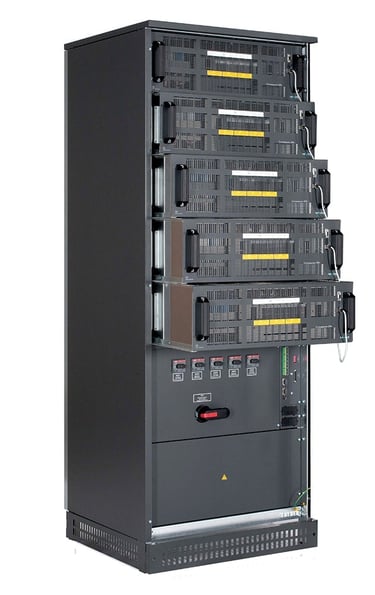
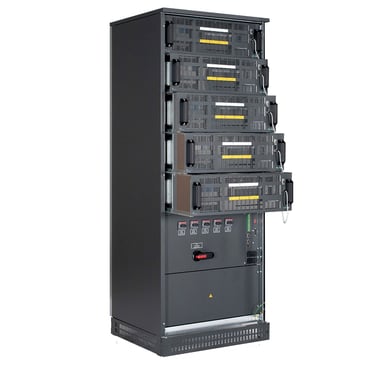
Topologies: Online double-conversion, line-interactive, and modular scalable frames with N+1 or greater redundancy for maximum uptime.
Distribution & Bypass: Static and maintenance bypass systems, PDUs, branch protection, and selective coordination for safe load transfer.
Generator Compatibility: Ride-through capability for walk-in and step-load conditions, frequency tracking, and smooth retransfer to utility.
Power Quality: Harmonic mitigation, power-factor correction, and low-THDi rectifiers to stabilize upstream networks and improve efficiency.
Monitoring & Control: Integration via SNMP/Modbus to BMS/DCIM, role-based dashboards, alarms, trending, and automated test routines.
Services: Survey, design, supply, installation, commissioning, documentation, training, and lifecycle support under defined SLAs.
Design Approach
We start with load profiling, autonomy targets, and growth scenarios to determine risk tolerance and system resilience.
Our engineers right-size UPS capacity, verify short-circuit withstand and fault-clearing coordination, and conduct thermal and spatial studies for battery rooms, ventilation, and cable routing.
Designs ensure safe access, isolation points, and low MTTR (Mean Time To Repair) through clear maintenance pathways and documented procedures.
Battery Systems
We engineer battery solutions that balance energy density, safety, and cost efficiency:
Technologies: VRLA (AGM/GEL) and Lithium-Ion options
Configuration: Defined string counts, intertier cabling, and protective devices
Safety: Flame-retardant racks, seismic restraints, and ventilation planning
Monitoring: BMS tracking cell voltage, internal resistance, and temperature for predictive maintenance
Where suitable, opportunity charging and eco-mode reduce energy use without compromising availability.
Integration
UPS systems are coordinated with upstream switchgear and downstream IT/process loads:
Detailed neutral and grounding schemes
EPO/ESD logic for emergency control
Parallel load-sharing and backfeed protection for multi-module systems
Status signals mapped to fire panels and building automation systems for unified monitoring
Commissioning
Commissioning includes:
Factory and Site Acceptance Tests (FAT/SAT)
Functional verification, step-load, and battery discharge tests
Thermal imaging and meter calibration
Deliverables include as-built drawings, single-line diagrams, protection settings, and O&M manuals.
Operator training covers normal, bypass, and emergency procedures plus battery maintenance and reporting.
Lifecycle Services
Our preventive and predictive maintenance programs include:
Firmware lifecycle management
Periodic discharge tests and torque verification
Thermography and environmental inspections
24/7 remote monitoring of alarms, run hours, and capacity trends
Spares strategies and SLA-defined response/restore targets ensure continuous availability and controlled TCO (Total Cost of Ownership).
Compliance & Safety
All designs comply with IEC standards, local electrical codes, and NFPA 70/NEC where applicable.
Standard practices include method statements, risk assessments, lockout/tagout, and battery-room safety measures (ventilation, spill kits, eyewash, signage).All test instruments are calibrated and traceable, ensuring verifiable compliance and operational safety.
FAQ
What is UPS?
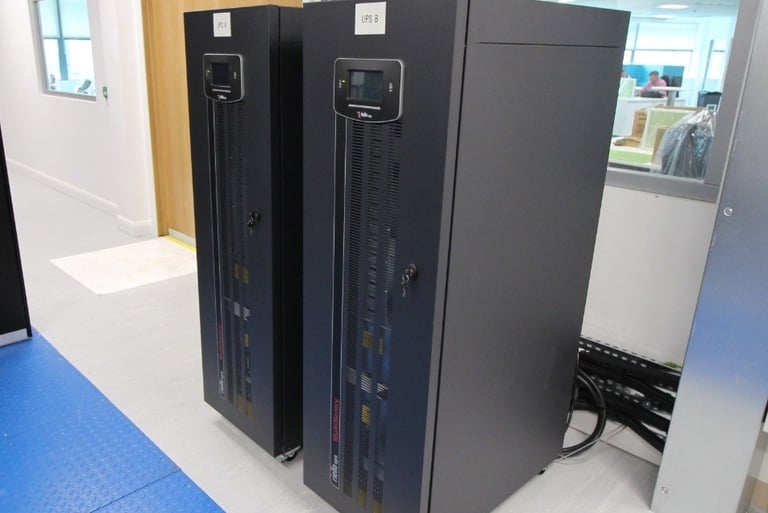
A UPS (Uninterruptible Power Supply) conditions utility power and bridges outages using batteries or flywheels.
It delivers clean, stable voltage and frequency to critical loads, protecting equipment from sags, surges, noise, and short interruptions.
How does it work?
During normal operation, the rectifier and inverter stabilize incoming power.
If utility power fails, the battery instantly supports the inverter no interruption is seen by the loads.
When power returns, the charger restores battery capacity and the system reverts automatically to normal mode.
What types of UPS systems exist?
Online Double-Conversion: Provides the highest protection by continuously converting and conditioning power.
Line-Interactive: Corrects moderate disturbances using Automatic Voltage Regulation (AVR); ideal for medium-critical systems.
Offline/Standby: Basic design that switches to battery only during failure—suitable for non-critical applications.
What is load profiling?
Load profiling defines what the UPS must support:
Power demand (kW/kVA)
Inrush and step loads
Power factor and harmonics
Required runtime and expansion margin
Ambient and altitude derating
Accurate profiling ensures right-sizing of the UPS, battery capacity, cabling, and protection devices, optimizing cost while maintaining availability and reliability.
What is redundancy?
Redundancy ensures operation even if one unit fails or is under maintenance:
N+1: One additional module beyond demand for fault tolerance.
2N: Full duplication of the entire system for mission-critical applications.
Proper redundancy eliminates single points of failure and shortens recovery time after a fault.
How to choose a UPS?
Select a UPS based on:
Critical load capacity (kW/kVA) and required autonomy
Redundancy goals (N+1 or 2N)
Installation environment and available space
Short-circuit withstand and generator compatibility
Maintenance bypass, remote monitoring, and safety compliance
Use lifecycle cost analysis to balance CAPEX, energy efficiency, battery longevity, and service costs—achieving sustained performance with minimum total cost of ownership (TCO).
Contact
Get in touch
Support
Follow
0503097003
Copyright © 2025 EPTCO All rights reserved
0112422995
0590061269
0112422995

