

Reliable Power Solutions
Engineering advanced battery systems for superior performance.
Reliable Power Solutions
We design, supply, install, and maintain dependable power systems that keep critical operations online. Our portfolio covers on-site generation, power distribution, UPS architectures, and industrial batteries all engineered to deliver clean power, fast recovery, and predictable lifecycle cost across industrial, commercial, and mission-critical environments.



Design
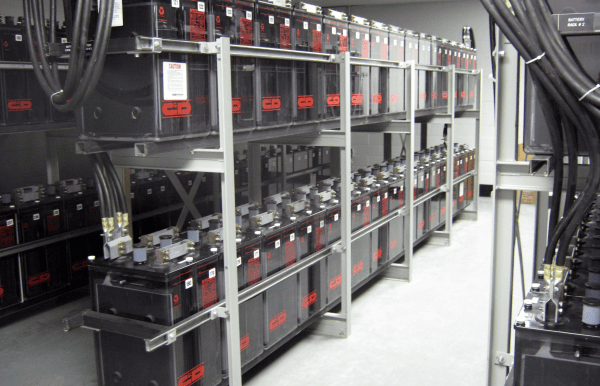
Custom electrical and mechanical design for reliable power. We define string configurations, cable sizing, protections, and charger compatibility, then engineer flame-retardant racks, ventilation, seismic restraints, and service clearances. Results: efficient layouts, safe operation, easy maintenance, and standards-compliant performance.
Monitoring
Advanced battery monitoring for safety and uptime. We track cell voltage, internal resistance, temperature, SOC/SOH, and events with calibrated sensors. Dashboards and SNMP/Modbus alarms enable trend analysis, early warnings, and compliance reports to optimize maintenance, extend life, and reduce downtime.
What We Deliver
We start with a structured assessment of loads, duty cycles, ambient conditions, and growth scenarios.
The findings define right-sizing of generators and UPS ratings, protection coordination, and redundancy targets such as N+1 or 2N.
Solutions include:
Diesel or gas gensets with alternators and paralleling switchgear
ATS/AMF systems for safe transfer
Power distribution with static and maintenance bypass
BMS/SCADA or DCIM integration for alarms, trending, and automated testing
Generation and Distribution
Genset systems designed for step-load performance, harmonic control, and derating under altitude and temperature conditions.
Full fuel infrastructure design: day/bulk tanks, fuel polishing, leak detection, containment, and ventilation safety.
Exhaust and thermal management engineered to meet occupational and community noise limits.
Downstream distribution includes PDUs, transformers, and selective coordination for asset protection and maintenance simplicity.
UPS Architectures
Deployment of online double-conversion and modular UPS with N+1 redundancy for continuous, stable power.
Inclusion of static and maintenance bypass, neutral/grounding schemes, and backfeed protection.
Generator compatibility tested for smooth walk-in and retransfer.
Commissioning verifies autonomy, step-load, and discharge performance, supported by operator training and SOP documentation.
Industrial & Motive-Power Batteries
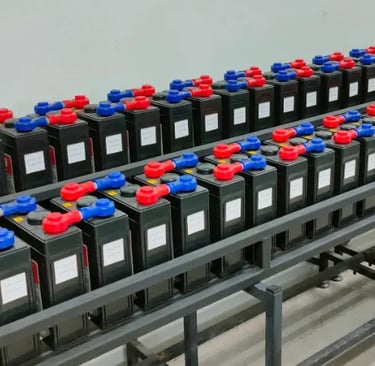
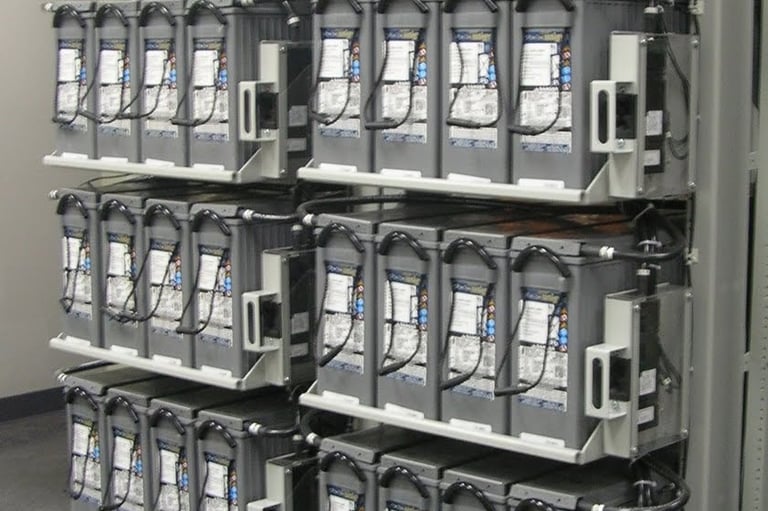
We engineer battery systems that balance autonomy, footprint, and safety requirements across UPS rooms and motive fleets.
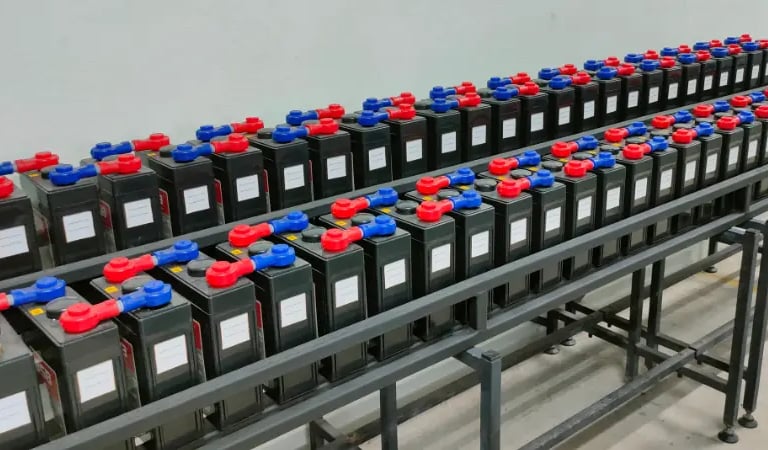
Chemistries: VRLA AGM/GEL and Lithium-ion, selected by energy density, cycle life, and thermal profile.
Electrical design: string configuration, cable sizing, short-circuit protection, and charger compatibility.
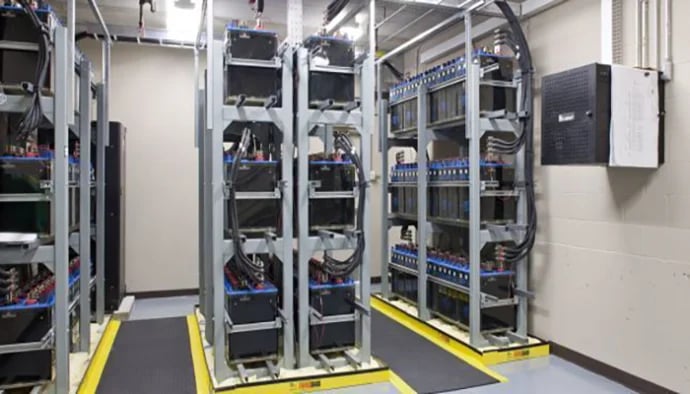
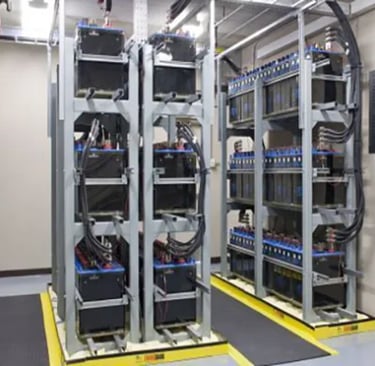
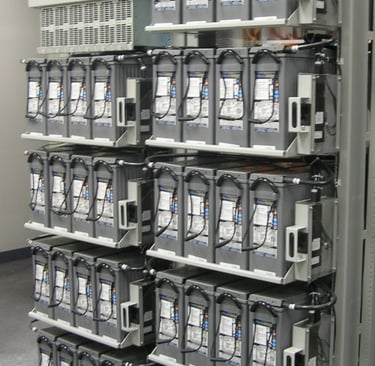
Mechanical design: flame-retardant racks, seismic bracing, and ventilation compliance.
Battery management: continuous tracking of cell voltage, internal resistance, and temperature.
Maintenance programs: open-circuit voltage checks, discharge testing, torque verification, thermography, and capacity trending to predict end-of-life.
Golf Cart Batteries
We stock and integrate high-reliability golf cart batteries for leisure and industrial fleets.
Options include deep-cycle AGM and lithium-ion packs with matched chargers and BMS settings, offering longer runtime, faster charging, and lower maintenance for resort, campus, and warehouse applications.
Service and Support
Our lifecycle model provides:
Preventive and corrective maintenance
Genuine spare parts
24/7 call-out service
Defined SLAs with response and restoration targets
Remote monitoring for condition-based decisions that enhance availability and lower TCO
Documentation includes as-built drawings, single-line diagrams, ITPs, FAT/SAT records, and O&M manuals.
Compliance and Quality
All designs comply with IEC, NFPA, and local regulatory codes.
We follow method statements, risk assessments, permit-to-work, and lockout/tagout (LOTO) procedures.
Calibrated instruments and audited QA/QC processes ensure repeatable, verifiable quality.
Brands We Support
CSB, Eastman, Leoch, Fiamm, Yuasa, Marathon, Powerfit, Classic, Sonnenschein, Sprinter, HAWKER, and leading generator and UPS OEMs trusted worldwide.






FAQs
What is battery monitoring?
Battery monitoring continuously measures cell voltage, temperature, and internal resistance, calculating both state-of-charge (SoC) and state-of-health (SoH).
It records all events and provides dashboards with SNMP/Modbus alarms for trend analysis and early fault detection, enabling predictive maintenance and ensuring safe, reliable operation.
How do you ensure safety?
We apply:
Flame-retardant racks and compliant ventilation systems
Seismic restraints and spill/eye-wash provisions
Electrical protection: fusing, short-circuit safeguards, insulated cabling, and lockout/tagout (LOTO) procedures
Battery Management System (BMS) with automated limits and alarms
All designs conform to IEC/UL standards and manufacturer recommendations, implemented by trained technicians under documented safety protocols.
What types of batteries do you use?
We deploy:
VRLA AGM/GEL and lithium-ion (LFP or NMC) batteries
Flooded lead-acid for motive-power and golf-cart applications
Battery selection is optimized for energy density, cycle life, charging time, temperature tolerance, maintenance needs, footprint, and cost, meeting both autonomy and safety requirements.
What is cycle life?
Cycle life is the number of charge–discharge cycles until capacity drops to a defined threshold (typically 80% of original).
It depends on depth of discharge (DoD), temperature, C-rate, and maintenance quality.
Typical ranges:
VRLA: ~300–1,200 cycles
Lithium-ion: ~2,000–6,000+ cycles
What is charge acceptance?
Charge acceptance measures how much current a battery can safely absorb at a given state-of-charge and temperature.
Higher acceptance allows faster recharge and less downtime, but requires:
Compatible chargers
Correct charging profiles
Thermal management to safeguard both lifespan and operational safety.
Contact
Get in touch
Support
Follow
0503097003
Copyright © 2025 EPTCO All rights reserved
0112422995
0590061269
0112422995

